
IVF or ICSI: Which Assisted Reproductive Method is Better?
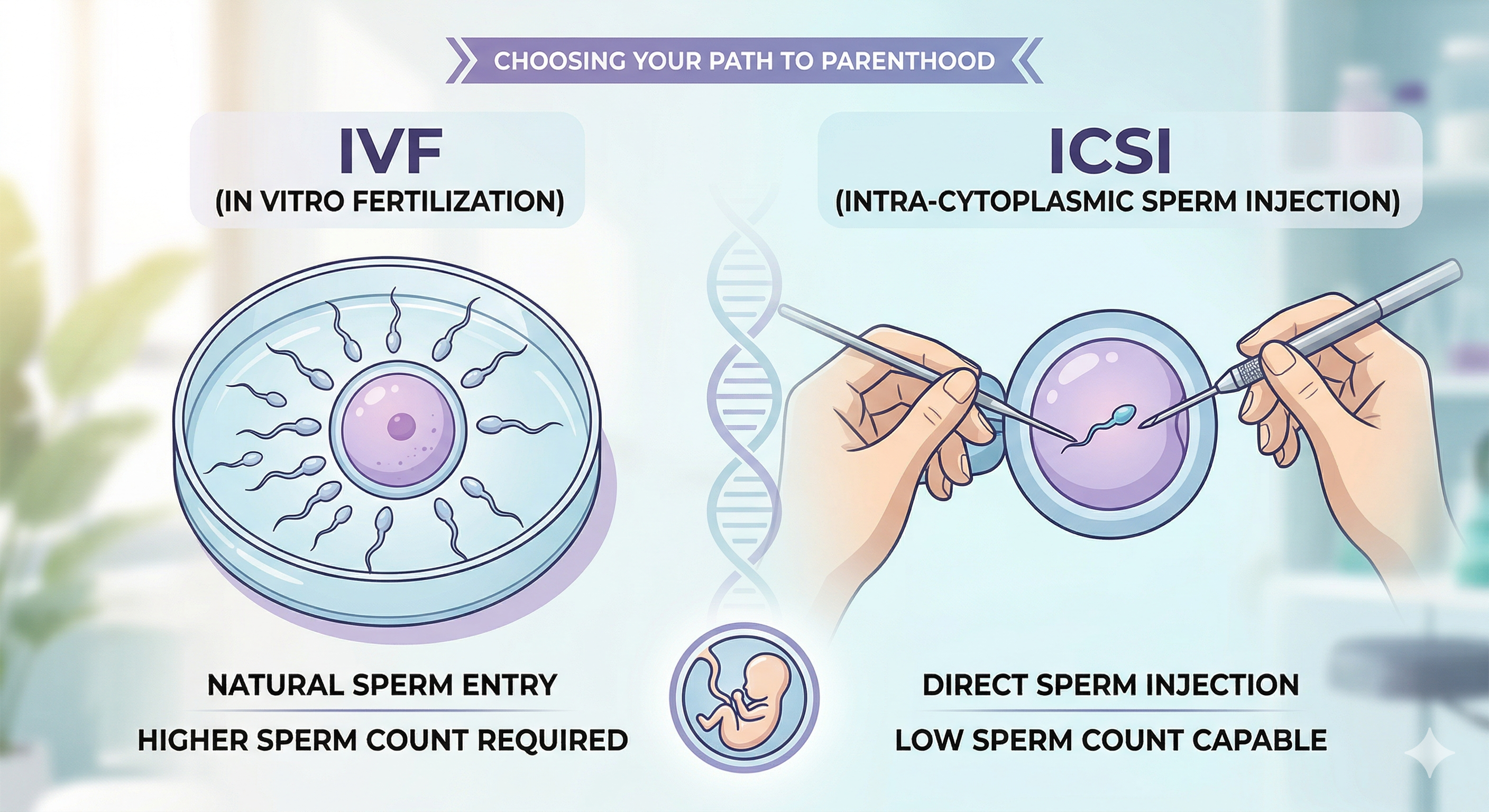
Quick Answer: Neither IVF nor ICSI is universally "better" — the right choice depends on your fertility diagnosis. IVF (In Vitro Fertilization) suits couples with female-factor or unexplained infertility. ICSI (Intracytoplasmic Sperm Injection) is preferred when there is severe male-factor infertility, surgically retrieved sperm, or previous IVF fertilization failure. At Myra IVF Centre in Kenya, both treatments are offered — and the decision is made after a complete fertility workup.
IVF vs ICSI at a Glance
- IVF — Eggs and sperm are mixed in a lab dish; fertilization happens naturally. Best for tubal, ovulatory, hormonal or unexplained infertility.
- ICSI — A single sperm is injected directly into each egg with a microneedle. Best for male-factor infertility, low sperm count/motility, TESA/PESA sperm, or repeat IVF fertilization failure.
- Success rate — Once a healthy embryo is formed, IVF and ICSI have similar pregnancy rates. ICSI improves the fertilization step in male-factor cases.
- Cost in Kenya — Contact Myra IVF Centre for current IVF pricing. ICSI is added on top of an IVF cycle.
- Risk profile — Similar to IVF; ICSI carries a slightly higher risk of inherited genetic conditions when infertility is genetic in origin.
Almost every couple wishes to experience the joy of becoming parents. However, some couples face difficulty conceiving naturally due to a variety of medical reasons. In such cases, assisted reproductive technologies such as IVF and ICSI can help them achieve their dream of having a child. In this article, we explain the key differences between these two methods and how to decide which one may be more suitable for your specific fertility situation — particularly for patients in Kenya and East Africa.
Difference between IVF and ICSI
Understanding IVF and ICSI
IVF, or In Vitro Fertilization is a medical procedure helping couples to conceive. The process involves combining an egg and sperm outside the body in a laboratory. If the egg fertilizes then the embryo is placed in the woman’s uterus. IVF is used when natural conception is challenging and this procedure offers hope to couples struggling to become parents.
ICSI, or Intracytoplasmic Sperm Injection is a fertility treatment where a single sperm is directly injected into an egg to assist in fertilization. It is a precise method that increases the chances of successful fertilization, especially when traditional methods might not be effective. ICSI is often recommended when there are sperm-related issues.
Procedure
In IVF (In Vitro Fertilization) the woman’s ovaries are stimulated to produce multiple eggs. These eggs are then retrieved and fertilized with sperm in the laboratory. After fertilization, the embryos are monitored for a few days and then the IVF specialist implants the fertilized eggs into the woman’s body.
ICSI (Intracytoplasmic Sperm Injection) is a specialized form of IVF where a single sperm is directly injected into an egg using a microneedle. This technique is beneficial when there are issues with sperm quality or if fertilization difficulties have been faced in previous IVF attempts.
Success Rate
The success rate of IVF varies depending on various factors like a woman’s age, overall health, sperm quality, and the causes of infertility. In many cases, it is observed that women under the age of 35 carry out the most successful treatment and the success rate declines with increasing age.
ICSI procedure is done when male infertility is a major concern. It is a procedure that has shown a higher success rate in cases of severe male infertility as compared to the traditional IVF method.
Complications Involved
At Myra IVF, our experienced team performs the IVF procedure with utmost care. However, some risks are always involved. While undergoing IVF treatment a woman can suffer from different complications like stress, miscarriage, ectopic pregnancy, and chances of multiple pregnancies.
While the overall complications of ICSI are similar to IVF, there is a slightly increased risk of the child having certain genetic disorders. It is majorly because the selected sperm may carry genetic abnormalities that could be transferred to the embryo. At Myra IVF, we provide the ICSI treatment with advanced technology.
Cost
At Myra IVF, the cost of IVF can be influenced by the number of cycles needed, medication expenses, and additional procedures. Contact us for current pricing details.
ICSI is typically an additional cost on top of the IVF procedure. The extra expense is associated with the specialized equipment and expertise required for the microinjection of sperm into eggs.
Process of IVF and ICSI
In Vitro Fertilization (IVF) process –
- Ovulation Stimulation – The first step in IVF involves stimulating the ovaries to produce multiple eggs. It is done with hormonal medications.
- Egg Retrieval – Once the eggs are mature with the minor surgical procedure these are collected from the ovaries. It is usually done with a thin needle.
- Sperm Collection – A sperm sample is collected from the male partner or a sperm donor.
- Fertilization – In a laboratory, eggs, and sperm are combined for fertilization. The fertilized eggs which are called embryos are monitored for a few days.
- Embryo Transfer – The best-quality embryos are selected and transferred into the woman’s uterus. It’s a relatively simple and painless procedure.
- Wait for Pregnancy – After the embryo transfer, the woman waits to check if she is pregnant. A pregnancy test is done a few weeks after the procedure.
Intracytoplasmic Sperm Injection (ICSI) process –
- Egg Retrieval – Similar to IVF, the woman undergoes ovulation stimulation and egg retrieval procedures.
- Sperm Selection & Injection – Instead of simply combining eggs and sperm, a single sperm is selected and injected directly into an egg using a tiny needle.
- Fertilization Check – The IVF specialist monitors the eggs for fertilization and the development of embryos.
- Embryo Transfer – The best embryos are selected and transferred into the woman’s uterus, similar to IVF.
- Wait for Pregnancy – After the successful embryo transfer, the woman waits to check if she is pregnant. A pregnancy test is done a few weeks after the procedure.
Which is better IVF or ICSI?
Both IVF (In Vitro Fertilization) and ICSI ( Intracytoplasmic Sperm Injection) are assisted reproductive methods, but these both differ in the fertilization process. IVF involves combining eggs and sperm in a laboratory. ICSI, on the other hand, is a more specialized form of IVF where a single sperm is directly injected into an egg. Both of the methods have their unique differences in procedure, cost, success rate, and complications.
The choice between IVF and ICSI depends on specific fertility issues. ICSI is preferred when there are severe male infertility issues or challenges with fertilization. IVF is a broader approach suitable for various fertility conditions. The decision should be based on individual circumstances, age, and other factors. At Myra IVF, our team of fertility doctors conducts the required diagnostic test before suggesting a suitable fertility treatment.
IVF and ICSI Treatment in Kenya and East Africa
For many years, intended parents in Kenya, Uganda, Tanzania and Rwanda travelled to India, South Africa or the Middle East for advanced fertility care. That is no longer necessary. Myra IVF Centre brings internationally standardised IVF and ICSI treatment to East Africa with branches in Nairobi (Westlands), Mombasa and Kisumu. The clinic combines an experienced embryology team, advanced micromanipulation equipment for ICSI, and transparent pricing — so couples can access world-class fertility care close to home.
Patients receive a full diagnostic workup — including semen analysis, hormonal profiling and ovarian-reserve assessment — before a personalised IVF or ICSI plan is recommended. Online consultations are available for patients travelling from outside Nairobi.
Conclusion
Both IVF and ICSI are advanced fertility treatments, and the right choice depends on individual factors — sperm quality, the woman's age, ovarian reserve, prior treatment history and any underlying genetic conditions. At Myra IVF Centre we offer both, ensuring personalised care and the best possible outcome. Consult our IVF specialists to determine the most effective approach for your situation. Our commitment is to provide comprehensive support and guide you toward a hopeful and successful journey to parenthood.
Frequently Asked Questions About IVF and ICSI
What is the main difference between IVF and ICSI?
In conventional IVF, eggs and sperm are placed together in a laboratory dish so that fertilization happens naturally. In ICSI, a single healthy sperm is injected directly into each egg using a microneedle. ICSI is essentially a specialised form of IVF designed to overcome severe sperm-related fertility problems.
Which is better for male infertility — IVF or ICSI?
ICSI is the preferred treatment when there is severe male-factor infertility — such as very low sperm count, poor sperm motility, abnormal sperm morphology, or surgically retrieved sperm (TESA/PESA). For couples with normal sperm parameters, conventional IVF generally works just as well.
Does ICSI have a higher success rate than IVF?
ICSI has higher fertilization rates than IVF in cases of male-factor infertility, but once a healthy embryo is formed, the implantation and pregnancy rates of ICSI and IVF are very similar. The difference shows up mainly at the fertilization stage, not at the live-birth stage.
How much does IVF and ICSI cost in Kenya?
The cost of an IVF cycle at Myra IVF Centre depends on medications, additional procedures and the number of cycles required. ICSI is added on top of IVF as it requires extra laboratory work and microinjection equipment. Contact us for current pricing.
Is ICSI safe for the baby?
ICSI is considered safe and is used worldwide. There is a slightly higher chance of inheriting genetic abnormalities when the original cause of infertility is genetic. Genetic counselling and preimplantation genetic testing (PGT) help reduce this risk.
How do I know whether I need IVF or ICSI?
Your fertility specialist will recommend IVF or ICSI based on a semen analysis, hormonal tests, ovarian-reserve assessment, the woman's age and any previous fertility treatment outcomes. At Myra IVF Centre, all patients receive a complete diagnostic workup before a treatment plan is suggested.
Where can I get IVF and ICSI treatment in Kenya?
Myra IVF Centre offers both IVF and ICSI in Kenya, with branches in Nairobi (Westlands), Mombasa and Kisumu. The centre serves patients from across Kenya and East Africa, including Uganda, Tanzania and Rwanda.