IVF vs. ICSI: Which Fertility Treatment is Right for You?
Quick Answer: The key difference between IVF and ICSI is how the egg is fertilized. In IVF (In Vitro Fertilization), eggs and sperm are mixed together in a laboratory dish so fertilization happens on its own. In ICSI (Intra-Cytoplasmic Sperm Injection), an embryologist injects a single sperm directly into each egg with a microneedle. ICSI is essentially a specialised form of IVF used when there is severe male-factor infertility. Both treatments are available at Myra IVF Centre in Kenya.
IVF vs ICSI — Key Differences at a Glance
- Fertilization — IVF: natural; sperm penetrates the egg on its own. ICSI: manual; sperm is injected directly into the egg.
- Sperm needed — IVF: many healthy, motile sperm. ICSI: just one healthy sperm per egg.
- Best for — IVF: female-factor or unexplained infertility. ICSI: male-factor infertility, surgical sperm (TESA/PESA), or repeat IVF fertilization failure.
- Success rate — Once an embryo is formed, IVF and ICSI have similar pregnancy and live-birth rates.
- Cost in Kenya — Contact Myra IVF Centre for current IVF pricing; ICSI is added on top.
Choosing the right path to parenthood is a significant milestone. While both IVF and ICSI are highly successful forms of assisted reproductive technology (ART), understanding their technical differences is key to setting the right expectations for your journey.
IVF (In Vitro Fertilization) Explained
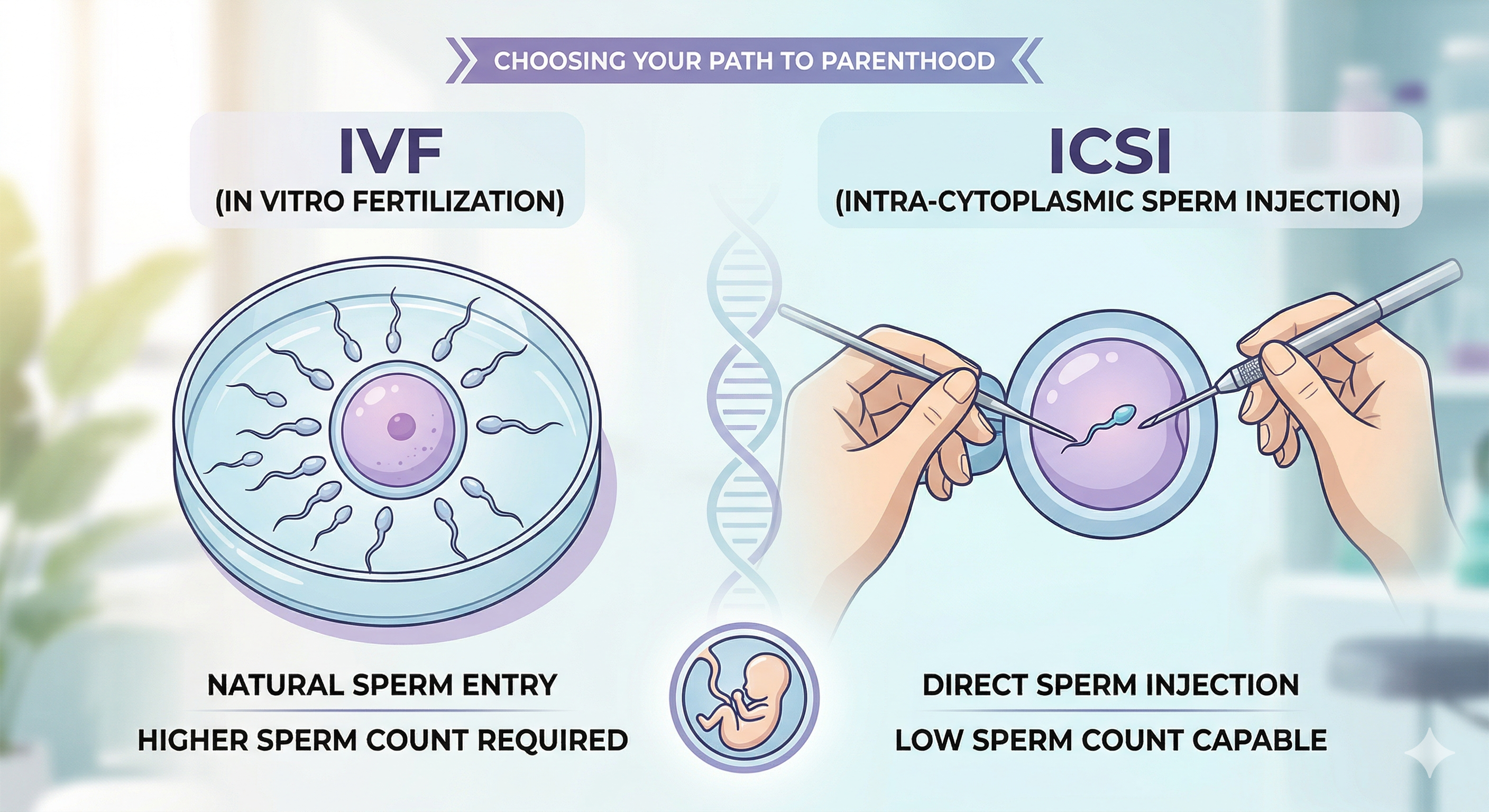
IVF is the foundational assisted reproductive technology where fertilization occurs outside the human body. It is often the first-line treatment for various fertility challenges.
- The Process: After eggs are retrieved, they are placed in a laboratory dish alongside a high concentration of healthy sperm.
- The Goal: This method allows for "natural selection" in a controlled environment—the sperm must independently swim to and penetrate the egg.
- Next Steps: Once fertilization occurs, embryos are nurtured in an incubator for 3–5 days before the most viable one is transferred to the womb.
ICSI (Intra-Cytoplasmic Sperm Injection) Explained
ICSI is a specialized variation of IVF. While the preparation and egg retrieval stages are identical to IVF, the fertilization stage is much more proactive.
- The Process: Instead of leaving the sperm and egg to find each other, an embryologist selects a single healthy sperm and manually injects it directly into the center of the egg.
- The Goal: This bypasses physical barriers to penetration, making it the gold-standard treatment for male-factor infertility.
Comparison at a Glance: IVF vs. ICSI
| Feature | IVF (In Vitro Fertilization) | ICSI (Intra-Cytoplasmic Sperm Injection) |
|---|---|---|
| Sperm Required | Requires a high count of healthy, motile sperm. | Only a single healthy sperm is needed per egg. |
| Fertilization Method | Sperm and eggs are mixed to fertilize "naturally" in a dish. | A single sperm is manually injected into the egg. |
| Sperm Entry | Sperm must penetrate the egg on its own. | Direct injection bypasses the egg's outer shell. |
| Primary Indication | Fallopian tube issues or unexplained infertility. | Severe male infertility (low count or motility). |
| Cost | Standard IVF cycle pricing. | Generally more expensive due to specialized lab work. |
Which One is Right for You?
The decision between IVF and ICSI usually depends on the results of a Semen Analysis. IVF is often preferred when sperm parameters are normal, while ICSI is recommended if there is a history of low fertilization or specific male-factor concerns.
IVF and ICSI Treatment in Kenya and East Africa
For many years, intended parents in Kenya, Uganda, Tanzania and Rwanda travelled to India, South Africa or the Middle East for advanced fertility care. That is no longer necessary. Myra IVF Centre brings internationally standardised IVF and ICSI treatment to East Africa with branches in Nairobi (Westlands), Mombasa and Kisumu. Our embryology lab is equipped for advanced micromanipulation, blastocyst culture and preimplantation genetic testing — bringing world-class fertility care closer to home.
Every patient receives a complete diagnostic workup — semen analysis, hormonal profiling and ovarian-reserve assessment — before a personalised IVF or ICSI plan is recommended. Online consultations are available for patients travelling from outside Nairobi.
Frequently Asked Questions About IVF and ICSI
What is the main difference between IVF and ICSI?
The main difference is the fertilization method. In IVF, sperm and eggs are placed together in a laboratory dish so they fertilize naturally. In ICSI, an embryologist manually injects a single live sperm directly into the centre of each egg using a microneedle.
Is ICSI better for male infertility?
Yes. ICSI is specifically recommended for male-factor infertility because it requires only a small number of healthy sperm and bypasses the egg's outer layer, making it the gold-standard treatment for low sperm count, poor motility, abnormal morphology or surgically retrieved sperm (TESA/PESA).
Is ICSI more expensive than IVF?
Yes. ICSI is generally more expensive than standard IVF because it requires specialised micromanipulation equipment, an experienced embryologist and additional laboratory time. ICSI is added on top of an IVF cycle's base cost.
Do IVF and ICSI have the same success rate?
ICSI achieves higher fertilization rates in male-factor cases, but once a healthy embryo is formed, the implantation and live-birth rates of IVF and ICSI are very similar. The biggest difference shows up at the fertilization step, not at the pregnancy stage.
Is ICSI safe for the baby?
ICSI is considered safe and is used worldwide. There is a slightly higher chance of inherited genetic conditions when the underlying cause of infertility is genetic. Genetic counselling and preimplantation genetic testing (PGT) help reduce this risk.
How do I know whether I need IVF or ICSI?
Your fertility specialist will recommend IVF or ICSI based on a semen analysis, hormonal tests, ovarian-reserve assessment, the woman's age and any previous fertility-treatment outcomes. At Myra IVF Centre, every patient receives a complete diagnostic workup before a treatment plan is suggested.
Where can I get IVF and ICSI treatment in Kenya?
Myra IVF Centre offers both IVF and ICSI in Kenya, with branches in Nairobi (Westlands), Mombasa and Kisumu. The clinic serves patients from across Kenya and East Africa, including Uganda, Tanzania and Rwanda.
Take the Next Step in Your Journey
Every fertility path is unique. Consult with our specialists to determine the best protocol for your family.
Book a Consultation