Blocked Fallopian Tubes: Causes, HSG Test & Treatment Options
Your periods are regular, you seem to ovulate every month, and your partner's semen analysis came back normal — yet pregnancy still isn't happening. For many women in Kenya, the hidden reason is blocked or damaged fallopian tubes. Tubal problems rarely cause symptoms, so they can go undetected for years. The good news: they are straightforward to test for, and there is a proven route to pregnancy for almost every type of tubal damage.
In this guide, the fertility specialists at Myra IVF Centre in Kenya, led by Dr. Sarita Sukhija, explain what blocked fallopian tubes are, why they are so common in East Africa, how the HSG test works, what a hydrosalpinx means for your treatment, and how to choose between tubal surgery and IVF.
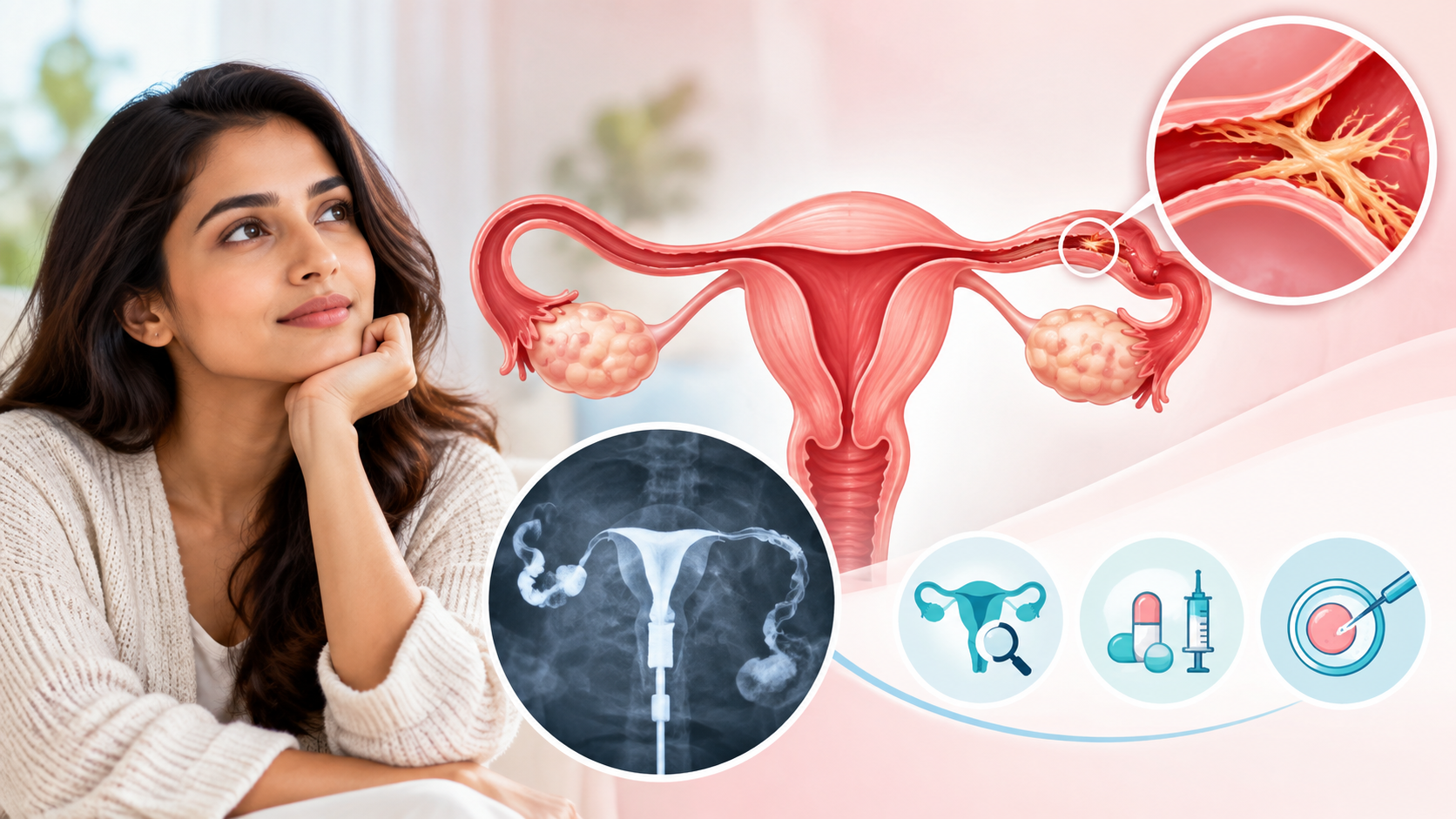
Quick Answer: Blocked fallopian tubes stop the egg and sperm from meeting, and account for an estimated 25–35% of female infertility — in sub-Saharan Africa, tubal damage is one of the leading causes. The most common cause is past pelvic infection, especially untreated chlamydia or gonorrhoea, which is often silent. Blockages usually cause no symptoms and are diagnosed with an HSG (hysterosalpingogram) X-ray dye test or laparoscopy. If one tube is open, natural conception or IUI is still possible. If both tubes are blocked, IVF is usually the most effective treatment because it bypasses the tubes entirely; selected cases can be treated with surgery. A fluid-filled tube (hydrosalpinx) should usually be removed or blocked before IVF, because the fluid can cut IVF success rates by up to half.
What Do the Fallopian Tubes Do?
The two fallopian tubes connect the uterus to the area around each ovary. Far from being simple pipes, they do remarkable work every month: the finger-like ends (fimbriae) sweep up the egg after ovulation; sperm swim up the tube to meet it; fertilisation takes place inside the tube; and tiny hair-like cells then carry the developing embryo down into the uterus over the next three to five days.
Because so much happens inside them, tubes can affect fertility in several ways. A tube can be completely blocked, partially narrowed, stuck down by scar tissue (adhesions) so the fimbriae cannot catch the egg, or open but damaged inside so the embryo is not carried along properly.
Types of Tubal Blockage
| Type | Where | Common causes | Usual treatment route |
|---|---|---|---|
| Proximal blockage | Where the tube joins the uterus | Infection, mucus or debris plugs, fibroids near the tube opening — or tubal spasm during testing | Confirm with a repeat test; tubal cannulation in selected cases; IVF |
| Mid-tube blockage | The middle section of the tube | Most often previous tubal ligation (sterilisation); sometimes TB or a past ectopic pregnancy | Tubal ligation reversal or IVF |
| Distal blockage / hydrosalpinx | The far (ovary) end of the tube, which seals and may fill with fluid | Pelvic inflammatory disease (PID), endometriosis, previous surgery | Removal or blocking of the damaged tube, then IVF; surgery to reopen only for mild cases |
| Peritubal adhesions | Scar tissue around the outside of the tubes and ovaries | PID, endometriosis, previous pelvic or abdominal surgery (including caesarean section or a burst appendix) | Laparoscopic removal of adhesions, or IVF |
What Causes Blocked Fallopian Tubes?
Most tubal damage is caused by inflammation and scarring. The main causes are:
- Pelvic inflammatory disease (PID) — infection of the uterus, tubes and ovaries, most often caused by chlamydia or gonorrhoea. These infections are frequently silent, so many women are never diagnosed or treated. Studies have found that roughly 1 in 10 women develop tubal infertility after a single episode of PID, with the risk rising sharply after repeated infections.
- Infection after childbirth, miscarriage or abortion — infection of the womb after a pregnancy, especially when care was delayed, can spread to the tubes. This is one reason women with secondary infertility (difficulty conceiving after a previous pregnancy) are often found to have tubal damage.
- Genital tuberculosis — in countries where TB is common, including Kenya, TB can silently infect the tubes and the lining of the womb. It is an under-recognised cause of tubal infertility and needs specific treatment before any fertility procedure.
- Endometriosis — can cause adhesions that distort or block the tubes (see endometriosis and fertility).
- Previous surgery or ectopic pregnancy — operations on the abdomen or pelvis, including caesarean sections, appendicitis and treatment for ectopic pregnancy, can leave scar tissue around the tubes.
- Tubal ligation (sterilisation) — the tubes are deliberately cut, clipped or tied as permanent contraception.
- Fibroids — a fibroid near the corner of the uterus can press on the tube opening (see fibroids and fertility).
Why is tubal infertility so common in East Africa? Research across sub-Saharan Africa has consistently found that tubal damage — mostly from past infections — makes up a far larger share of female infertility than in Europe or North America. Silent sexually transmitted infections, limited access to testing, and infections after delivery or pregnancy loss all play a part. The encouraging flip side is that much of it is preventable — and all of it is now treatable.
Does Family Planning Cause Blocked Tubes?
This is one of the most common worries we hear in Kenya — and the answer is no. Contraceptive pills, injections, implants and the copper or hormonal IUD (coil) do not cause blocked fallopian tubes. Research on women with tubal infertility has linked the damage to past infection — particularly chlamydia — not to IUD use. Fertility returns after you stop contraception, although after injectable contraception it can take several months. The only method designed to block the tubes is tubal ligation, which is intended to be permanent.
Symptoms: Why Blocked Tubes Often Go Unnoticed
Most women with blocked tubes have no symptoms at all — they have normal periods and feel completely well. The first sign is usually difficulty getting pregnant. Some women do notice:
- Ongoing pelvic or lower abdominal pain, sometimes on one side
- Painful periods or pain during sex — often from endometriosis or adhesions
- Unusual vaginal discharge — which may signal an active infection needing prompt treatment
- A previous ectopic pregnancy
Because symptoms are unreliable, your history matters more. Tell your doctor if you have ever had a pelvic infection or STI, a complicated delivery or miscarriage, abdominal surgery, TB or an ectopic pregnancy.
How Are Blocked Tubes Diagnosed? The HSG Test and Beyond
| Test | How it works | Advantages | Limitations |
|---|---|---|---|
| HSG (hysterosalpingogram) | Dye is passed through the cervix while X-ray images show whether it flows through the tubes | Widely available and quick; also outlines the shape of the uterine cavity | Uses X-rays; brief cramping; tubal spasm can mimic a blockage near the uterus |
| HyCoSy (contrast ultrasound) | The same principle, using ultrasound and a contrast fluid or foam | No radiation | Accuracy depends on operator experience; not available everywhere |
| Laparoscopy with dye test (chromopertubation) | Keyhole surgery: coloured dye is passed through the tubes and watched directly | The gold standard; also reveals adhesions and endometriosis, which can often be treated in the same operation | A surgical procedure under general anaesthesia |
| Chlamydia antibody blood test | Detects evidence of past chlamydia infection | Simple screening that helps estimate the likelihood of tubal damage | Does not show whether the tubes are actually blocked |
An ordinary ultrasound can sometimes show a hydrosalpinx (a swollen, fluid-filled tube), but a normal scan cannot confirm that the tubes are open.
What to expect during an HSG:
- Timing — after your period has finished but before ovulation, usually days 6–11 of your cycle, so there is no chance of an early pregnancy.
- The procedure — a speculum is inserted (as for a smear test), a fine tube is placed in the cervix and dye is gently injected while X-ray images are taken. The test itself usually takes about 10–15 minutes.
- Comfort — period-like cramping for a few minutes is common. A simple painkiller about an hour beforehand helps; ask your doctor which one is suitable.
- Afterwards — light spotting and sticky discharge for a day or two are normal. Antibiotics may be given if you have a history of pelvic infection. Report fever, worsening pain or foul-smelling discharge promptly.
- A possible bonus — some studies suggest a small rise in pregnancy rates in the months after an HSG, especially when oil-based dye is used, possibly because the dye flushes the tubes.
A blockage seen on HSG right where the tube meets the uterus is not always real — the tube can go into spasm during the test. If your HSG shows a proximal block, your specialist may suggest repeating it or confirming with laparoscopy before deciding on treatment.
Hydrosalpinx: Why It Matters So Much for IVF
A hydrosalpinx is a tube that is blocked at its far end and has filled with fluid. It deserves special attention, because the fluid doesn't just sit there — it can leak back into the uterus, where it is toxic to embryos and can physically wash them out of the womb.
Studies show that a hydrosalpinx can reduce IVF pregnancy rates by up to half and increase the risk of miscarriage. Removing the damaged tube (salpingectomy) or blocking it where it joins the uterus before IVF significantly improves the chance of success. That is why checking for a hydrosalpinx is an essential step before IVF for any woman with suspected tubal disease.
Many women understandably worry about "losing" a tube. It helps to know that a tube that is already badly damaged and fluid-filled is not contributing to your fertility — and IVF does not need the tubes at all, because the eggs are collected directly from the ovaries.
Treatment Options for Blocked Fallopian Tubes
The right treatment depends on where the tubes are blocked, how badly they are damaged, whether one or both tubes are affected, your age and ovarian reserve, your partner's semen analysis, and how many children you hope to have.
If only one tube is blocked. If the other tube is healthy and open and you ovulate normally, you can still conceive naturally. Your doctor may suggest timing intercourse — or IUI with ovulation monitoring (see how IUI works) — in cycles where you ovulate on the side of the open tube. If the blocked tube is a hydrosalpinx, removing it may improve the chance of natural conception as well as IVF.
Tubal surgery. Several procedures can be performed by laparoscopy (keyhole surgery) or hysteroscopy:
- Adhesiolysis — releasing scar tissue around the tubes and ovaries.
- Fimbrioplasty or salpingostomy — reopening or reconstructing the end of the tube; works best when damage is mild and the inner lining of the tube is healthy.
- Tubal cannulation — a fine catheter clears a blockage near the uterus.
- Tubal ligation reversal — microsurgery to rejoin the tubes after sterilisation. Success is best in younger women, when a good length of healthy tube remains and the partner's sperm is normal.
The advantage of successful surgery is that you can try to conceive naturally every month — and potentially have more than one child without further treatment. The disadvantages are recovery time, the months it takes to know whether it has worked, a higher-than-average risk of ectopic pregnancy afterwards, and much lower success when the tubes are severely damaged.
IVF — the most reliable option for severe tubal damage. IVF bypasses the fallopian tubes completely: eggs are collected directly from the ovaries, fertilised in the laboratory, and the embryo is placed straight into the uterus (see what to expect during egg retrieval and embryo transfer). In fact, IVF was invented for exactly this problem — Louise Brown, the world's first IVF baby, born in 1978, was conceived because her mother had blocked fallopian tubes. IVF is usually recommended when both tubes are blocked or severely damaged, when you are over 35 or have low ovarian reserve and time matters, when there is also male-factor infertility, or when tubal surgery has not worked.
| Factor | Tubal surgery | IVF |
|---|---|---|
| Best for | Mild damage, adhesions, sterilisation reversal, younger women | Both tubes blocked, severe damage, hydrosalpinx, age 35+, male-factor infertility |
| How you conceive | Naturally, month after month | Embryo transfer in each treatment cycle |
| Time to an answer | Often many months after recovery | A result within weeks of each cycle |
| Ectopic pregnancy risk | Higher than average | Still possible with tubal disease — an early scan is important |
| Future children | Possible without further treatment if the tubes stay open | Frozen embryos can be used for later pregnancies |
| Main limitation | Success falls sharply with severe damage | Cost per cycle and the need for ovarian stimulation |
Can "Natural Remedies" Unblock Fallopian Tubes?
We understand the appeal of a non-surgical fix, and many products are marketed in Kenya and online — herbal teas, "womb cleansing" pessaries, castor oil packs, fertility massage and steaming. There is no scientific evidence that any of these can open a blocked tube. Tubal blockages are made of scar tissue, which does not dissolve with herbs, and inserting products into the vagina can introduce new infection. The real cost is time: every month spent on unproven remedies is a month of declining egg quality, especially after 35 (see fertility after 35 and 40).
Preventing Tubal Damage
- Practise safer sex, and get tested for STIs — both partners — when starting a new relationship or planning a pregnancy.
- Treat infections promptly and completely: finish the full antibiotic course, and make sure your partner is treated too, so the infection is not passed back.
- Seek care quickly for fever, pelvic pain or foul-smelling discharge after delivery, miscarriage or any procedure on the womb.
- Complete TB treatment fully if you are diagnosed.
- If you are having trouble conceiving and have any history of pelvic infection, ask for your tubes to be checked early rather than waiting.
A Note on Ectopic Pregnancy
Damaged tubes increase the risk of an ectopic pregnancy, where the embryo implants in the tube instead of the uterus — a medical emergency. If you have known tubal disease or have had tubal surgery, contact your doctor as soon as you have a positive pregnancy test, so an early ultrasound at around six weeks can confirm the pregnancy is in the uterus. Seek urgent care for one-sided abdominal pain, shoulder-tip pain, vaginal bleeding, dizziness or fainting in early pregnancy.
Tubal Factor Care at Myra IVF Centre, Kenya
At Myra IVF Centre, women with suspected tubal problems receive complete, joined-up care:
- Complete tubal assessment — tubal testing such as HSG or laparoscopy with dye test, as part of a full fertility work-up for both partners.
- Laparoscopic surgery — removal of pelvic adhesions and tubal ligation reversal, through small keyhole incisions with a fast recovery.
- Hysteroscopy — to examine the uterine cavity and the openings of the fallopian tubes, and treat problems in the same sitting.
- IVF and ICSI in our ISO 9001 certified laboratory — bypassing the tubes entirely when that is the fastest, most reliable route.
- Three convenient locations — Nairobi, Mombasa and Kisumu.
With over 15 years of experience and a 79% overall IVF success rate, our team led by Dr. Sarita Sukhija has helped many couples with tubal factor infertility welcome their baby.
Conclusion
Blocked fallopian tubes are one of the most common — and most treatable — causes of infertility in Kenya. Because they rarely cause symptoms, the most important step is simply to get tested, especially if you have had a pelvic infection, a complicated delivery or miscarriage, or abdominal surgery. Once your tubes have been assessed, the path forward is usually clear: try naturally or with IUI if one tube is open, consider surgery for mild damage or a sterilisation reversal, and move to IVF when both tubes are blocked or time matters.
If you have been trying to conceive without success, don't spend more months wondering. Speak with our fertility specialists at Myra IVF Centre — a simple test can answer the question, and a clear plan can follow.
Book a consultation today. Contact us at +254 786656236 or drsarita2007@gmail.com.
Frequently Asked Questions
Can I get pregnant with blocked fallopian tubes?
If both tubes are completely blocked, natural pregnancy is not possible, because the egg and sperm cannot meet. However, IVF bypasses the tubes entirely and has excellent success rates for tubal factor infertility. If only one tube is blocked and the other is healthy, natural conception or IUI is still possible. Selected women can also have surgery to reopen or reconstruct the tubes.
What are the symptoms of blocked fallopian tubes?
Most women have no symptoms at all; the first sign is usually difficulty getting pregnant. Some women experience pelvic pain, painful periods, pain during sex or unusual vaginal discharge, often linked to an underlying cause such as pelvic infection or endometriosis. A history of pelvic infection, STIs, ectopic pregnancy or abdominal surgery raises the likelihood of tubal damage.
What causes blocked fallopian tubes?
The most common cause is pelvic inflammatory disease (PID), usually due to chlamydia or gonorrhoea infections that often cause no symptoms. Other causes include infection after childbirth, miscarriage or abortion, genital tuberculosis, endometriosis, previous pelvic or abdominal surgery, past ectopic pregnancy and tubal ligation (sterilisation).
How is an HSG test done, and is it painful?
An HSG (hysterosalpingogram) is done after your period ends and before ovulation, usually on days 6–11 of your cycle. A fine tube is placed in the cervix and dye is injected while X-ray images show whether it flows through the tubes. The test itself takes about 10–15 minutes. Most women feel period-like cramping for a few minutes, and a simple painkiller taken beforehand helps.
Can one blocked fallopian tube stop pregnancy?
Not on its own. If the other tube is open and healthy and you ovulate normally, you can still conceive naturally, although it may take longer. Timing intercourse or IUI to cycles where you ovulate on the side of the open tube can help. If the blocked tube is a fluid-filled hydrosalpinx, your doctor may recommend removing it, because the fluid can reduce pregnancy chances.
What is a hydrosalpinx and why does it affect IVF?
A hydrosalpinx is a fallopian tube that is blocked at its far end and filled with fluid. The fluid can leak into the uterus, where it is toxic to embryos and can wash them out, reducing IVF pregnancy rates by up to half and increasing miscarriage risk. Removing or blocking the affected tube before IVF significantly improves success rates.
Is IVF or surgery better for blocked tubes?
It depends on the type and severity of the damage, your age, your ovarian reserve and your partner's sperm. Surgery can work well for mild damage, adhesions or reversal of sterilisation in younger women, and allows natural conception each month. IVF is usually better when both tubes are severely damaged, when there is a hydrosalpinx, when you are over 35, or when there is also male-factor infertility.
Can blocked fallopian tubes be opened naturally?
No. There is no scientific evidence that herbs, teas, castor oil packs, massage, steaming or vaginal "cleansing" products can open a blocked tube. Tubal blockages are made of scar tissue, which does not dissolve with natural remedies, and inserting products into the vagina can cause infection. The proven options are tubal surgery in selected cases, or IVF.
Does family planning cause blocked fallopian tubes?
No. Contraceptive pills, injections, implants and the copper or hormonal IUD do not cause blocked tubes. Research has linked tubal infertility to past infections, particularly chlamydia, rather than to IUD use. Fertility returns after stopping contraception, though after injectables it can take several months. The only method designed to block the tubes is tubal ligation (sterilisation).
Can tubal ligation be reversed?
Yes, in many cases. Tubal ligation reversal is microsurgery that rejoins the remaining sections of the tubes. It works best in younger women when a good length of healthy tube remains and the partner's sperm is normal. Success is lower with some sterilisation methods and with increasing age, and the risk of ectopic pregnancy is higher afterwards. IVF is the main alternative and does not need the tubes at all.