Fibroids and Fertility: Can You Get Pregnant With Fibroids?
Being told you have fibroids can be frightening — especially when you are trying for a baby. Many women in Kenya hear the word and immediately fear the worst: that pregnancy is now impossible, or that the only answer is a hysterectomy. Neither is true. Fibroids are extremely common, most women with fibroids conceive without any treatment at all, and when fibroids do get in the way, they can usually be removed while keeping the womb — and your fertility — intact.
In this guide, the fertility specialists at Myra IVF Centre in Kenya, led by Dr. Sarita Sukhija, explain which fibroids affect fertility and which don't, when removing them genuinely improves your chances, the surgical options from hysteroscopic myomectomy to laparoscopy, how fibroids fit into IVF, and what to expect if you become pregnant with fibroids.
Quick Answer: Yes — most women with fibroids can get pregnant. Whether fibroids affect fertility depends mainly on their location, not just their size. Submucosal fibroids (bulging into the womb cavity) clearly lower pregnancy rates and raise miscarriage risk, and removing them with a hysteroscopic myomectomy improves the chance of conceiving. Subserosal fibroids (on the outer surface) usually have no effect on fertility. Intramural fibroids (inside the muscle wall) sit in between — they matter most when they are large or press on the cavity. Fibroids are found in 5–10% of women with infertility but are the only cause in around 1–2%, so both partners should be fully tested before any surgery is planned.
What Are Fibroids?
Uterine fibroids — medically called leiomyomas or myomas — are non-cancerous growths of the muscle tissue of the womb (uterus). They can be as small as a seed or as large as a melon, and many women have several at once. Their growth is driven by the hormones oestrogen and progesterone, which is why fibroids typically develop during the reproductive years, can grow during pregnancy, and usually shrink after menopause.
Fibroids are remarkably common. By the age of 50, around 70% of women have developed at least one — and the figure rises to over 80% among women of African descent, who also tend to develop fibroids at a younger age, in larger numbers and with more severe symptoms. For women in Kenya and across East Africa, fibroids are one of the most frequent gynaecological diagnoses, and often one that arrives just as they are planning a family.
Factors linked to a higher risk of fibroids include:
- African ancestry
- Age — fibroids are most common in the 30s and 40s
- Family history — if your mother or sister had fibroids
- Starting periods early
- Obesity and low vitamin D levels
- Never having been pregnant — pregnancy appears to have a protective effect
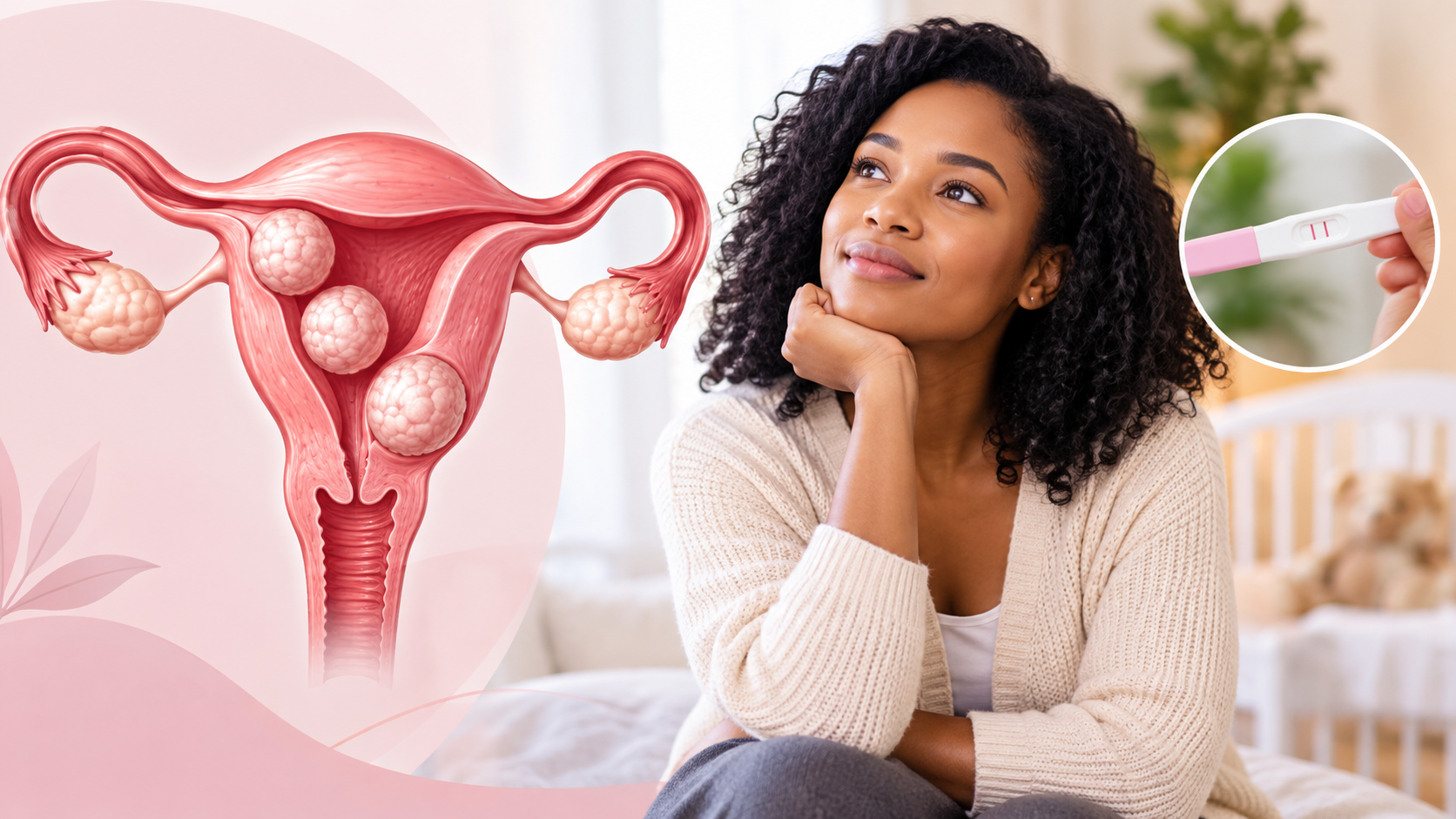
The Types of Fibroids — and Why Location Matters Most
Doctors classify fibroids by where they grow in the uterus, using a system developed by FIGO (the International Federation of Gynecology and Obstetrics). For fertility, location is far more important than size:
| Type | Where it grows | Effect on fertility | Usual approach if trying to conceive |
|---|---|---|---|
| Submucosal (FIGO 0–2) | Just under the womb lining, bulging into the cavity where an embryo implants | Clear negative effect — lower implantation and pregnancy rates, higher miscarriage risk | Removal by hysteroscopic myomectomy is usually recommended |
| Intramural (FIGO 3–5) | Within the muscular wall of the uterus | Depends — a modest effect when large (often over about 4 cm) or pressing on the cavity; small ones often have little effect | Individual decision based on size, number, symptoms and IVF plans |
| Subserosal (FIGO 6–7) | On the outer surface of the uterus, sometimes on a stalk (pedunculated) | Generally no effect on fertility | Usually left alone unless causing pain or pressure |
| Cervical and other (FIGO 8) | In the cervix or outside the body of the uterus | Can obstruct sperm and complicate embryo transfer or delivery | Assessed case by case |
This is why two women with "a 3 cm fibroid" can receive completely different advice. A 3 cm submucosal fibroid inside the cavity is worth removing before trying to conceive; a 3 cm subserosal fibroid on the outside of the uterus is usually best left exactly where it is.
How Do Fibroids Affect Fertility?
Fibroids can interfere with conception and early pregnancy in several ways:
- Distorting the uterine cavity — submucosal and some intramural fibroids change the shape of the space where the embryo must implant.
- Affecting the womb lining — fibroids can alter blood flow and the signals that make the endometrium receptive to an embryo, even in parts of the lining away from the fibroid itself.
- Blocking the fallopian tubes — a fibroid near the upper corners of the uterus can press on the openings of the tubes (see our guide to blocked fallopian tubes).
- Obstructing the cervix — a cervical fibroid can make it harder for sperm to pass and can complicate IUI or embryo transfer.
- Disrupting uterine contractions — fibroids can interfere with the gentle, wave-like contractions that help sperm and embryos move to the right place.
The research on submucosal fibroids is clear. A major review of the evidence found that women with submucosal fibroids had roughly one-third the chance of implantation and live birth compared with women without fibroids, along with a higher miscarriage rate — and that removing these fibroids improved pregnancy rates. For subserosal fibroids, no such effect has been found.
Just as important is what fibroids usually don't explain. Fibroids are present in 5–10% of women with infertility, but they are the sole cause in only around 1–2% of cases. So if you are struggling to conceive and a scan shows a fibroid, it is essential to complete a full fertility work-up — ovulation, ovarian reserve (AMH), the fallopian tubes and a semen analysis — before assuming the fibroid is the problem. Surgery for a fibroid that was never the real cause costs months you may not have.
Symptoms: When to Suspect Fibroids
Many women with fibroids have no symptoms at all and only discover them on a routine scan. When symptoms do occur, the most common are:
- Heavy or prolonged periods, sometimes with clots — often leading to iron-deficiency anaemia, tiredness and breathlessness
- Pelvic pressure, fullness or a swollen lower abdomen
- Frequent urination or constipation, from a fibroid pressing on the bladder or bowel
- Lower back pain or pain during sex
- Difficulty conceiving or repeated miscarriage
Heavy bleeding that soaks through pads every hour, leaves you exhausted, or keeps you home from work is not something to simply endure. It deserves investigation — whether or not you are planning a pregnancy right now.
How Are Fibroids Diagnosed?
For fertility planning, the goal is not just to confirm that fibroids are present but to map them precisely — their number, size and exact relationship to the womb cavity:
- Transvaginal ultrasound — the first-line test: quick, painless and widely available. 3D ultrasound gives an even clearer picture of the cavity.
- Saline infusion sonography (SIS) — a small amount of sterile saline is placed in the uterus during the scan, outlining the cavity and showing exactly how far a fibroid protrudes into it.
- Hysteroscopy — a thin camera passed through the cervix looks directly inside the uterus. Submucosal fibroids can often be removed in the same procedure.
- MRI — used when there are many or very large fibroids, to plan surgery in detail.
Alongside fibroid mapping, we always recommend a complete fertility assessment for both partners, so that the treatment plan addresses every factor at once.
Treatment Options If You Want to Get Pregnant
The right treatment depends on the type, size and number of fibroids, your age and ovarian reserve, your symptoms, and whether you plan to conceive naturally or with IVF. These are the main options:
| Option | Best for | Recovery | When you can try to conceive |
|---|---|---|---|
| Monitoring | Small subserosal or intramural fibroids that don't touch the cavity and cause no symptoms | None | Straight away |
| Hysteroscopic myomectomy | Submucosal fibroids — removed through the cervix with no abdominal cuts | Day case; back to normal in 1–2 days | Usually after 1–3 months, depending on fibroid size and depth |
| Laparoscopic myomectomy | Selected intramural and subserosal fibroids — keyhole surgery | About 1–2 weeks | Typically after 3–6 months, to let the uterine wall heal |
| Open (abdominal) myomectomy | Very large or numerous fibroids | About 4–6 weeks | Typically after 3–6 months |
| Medication | Controlling heavy bleeding, correcting anaemia, or shrinking fibroids before surgery | — | Not a fertility treatment — hormonal medicines that shrink fibroids also stop ovulation |
Two points about surgery are worth knowing. First, if a myomectomy involved deep cuts into the uterine wall, your doctor may recommend delivering future babies by planned caesarean section, to avoid the small risk of the scar opening during labour. Second, new fibroids can grow in the years after a myomectomy — one reason surgery is best timed close to when you plan to conceive, rather than years in advance.
Treatments to avoid if you want a baby. Some fibroid treatments are good for symptom relief but are not recommended for women planning a pregnancy. Uterine artery embolisation (UAE), which blocks the fibroid's blood supply, has been linked to higher miscarriage rates, and its pregnancy data is less reassuring than for myomectomy. Radiofrequency ablation and focused ultrasound (HIFU) have limited pregnancy data. Endometrial ablation and hysterectomy end the possibility of carrying a pregnancy. If you have been advised to have a hysterectomy for fibroids and still hope to have children, please get a second opinion from a fertility specialist first — in most cases, a womb-sparing option exists.
Surgery First or IVF First?
For women who need IVF anyway — because of age, low ovarian reserve, blocked tubes or male-factor infertility — the order of treatment matters:
- If a fibroid distorts the cavity: it is usually removed before embryo transfer, because a submucosal fibroid lowers the chance of implantation and raises the risk of miscarriage.
- If time is short: for women over 35 or with low AMH, one strategy worth discussing with your specialist is to stimulate the ovaries and freeze embryos first, have the myomectomy, then transfer a frozen embryo once the uterus has healed. This protects egg quality during the months of recovery (see frozen vs fresh embryo transfer).
- If intramural fibroids don't touch the cavity: management is individual. Larger intramural fibroids may modestly reduce IVF success, but surgery has its own costs in recovery time and scarring. Your specialist will weigh size, number and your timeline.
- If the uterus cannot safely carry a pregnancy: rarely — with very many or very large fibroids, or after multiple operations — pregnancy may not be safe. In these situations, gestational surrogacy using your own embryos can be an option.
Pregnancy With Fibroids: What to Expect
Most women with fibroids have healthy pregnancies and deliveries. Most fibroids stay about the same size during pregnancy; some grow, mainly in the first trimester. Possible issues to be aware of include:
- Pain from "red degeneration" — when a fibroid outgrows its blood supply. It is usually managed with rest and pregnancy-safe pain relief.
- A somewhat higher risk of miscarriage, preterm labour, the baby lying in a breech position, placental problems and caesarean delivery — particularly with large or multiple fibroids, or fibroids close to the placenta.
- Heavier bleeding after birth (postpartum haemorrhage), which your delivery team can plan for in advance.
If you have fibroids, tell your antenatal team early. An early scan that maps the fibroids in relation to the pregnancy and placenta allows any risks to be anticipated and monitored.
Fibroid Myths That Cost Women Time
| Myth | Fact |
|---|---|
| "You can't get pregnant with fibroids." | Most women with fibroids conceive naturally. Only fibroids in certain positions affect fertility. |
| "All fibroids must be removed before trying to conceive." | Subserosal and small intramural fibroids are usually best left alone — unnecessary surgery can create scar tissue and delays trying. |
| "Hysterectomy is the only cure." | Myomectomy removes fibroids while keeping the uterus. Hysterectomy is a last resort for women who have completed their families. |
| "Fibroids are cancer, or turn into cancer." | Fibroids are benign. Cancer of the uterine muscle (leiomyosarcoma) is very rare and is not thought to develop from ordinary fibroids. |
| "Herbal teas or 'womb detox' products dissolve fibroids." | There is no reliable evidence that any herbal product shrinks fibroids — and relying on them delays proper diagnosis while fibroids, and the fertility clock, keep moving. |
Fibroid Care at Myra IVF Centre, Kenya
At Myra IVF Centre, women with fibroids receive fertility-first care, where every decision is made with your future family in mind:
- Precise fibroid mapping — detailed ultrasound and diagnostic hysteroscopy to classify every fibroid by type and position.
- Hysteroscopic myomectomy — removal of submucosal fibroids through the cervix, with no abdominal incision, as a day-case procedure.
- Laparoscopic myomectomy — keyhole removal of selected intramural and subserosal fibroids, with faster recovery than open surgery.
- A full work-up for both partners — so surgery happens only when it will genuinely help, and is timed around your natural conception or IVF plans.
- IVF, embryo freezing and surrogacy — when fibroids are one part of a bigger fertility picture.
- Three convenient locations — Nairobi, Mombasa and Kisumu.
With over 15 years of experience and a 79% overall IVF success rate, our team led by Dr. Sarita Sukhija helps women with fibroids build their families — keeping the uterus, and your options, intact wherever possible.
Conclusion
Fibroids are common, usually harmless to fertility, and — when they do get in the way — very treatable. The questions that matter are where your fibroids are, whether they reach the womb cavity, and what else is affecting your fertility. Answer those, and the right plan usually becomes clear: leave them alone, remove them with the least invasive surgery possible, or work around them with IVF.
If you have been diagnosed with fibroids and are hoping to conceive, don't wait for symptoms to get worse — and don't accept a hysterectomy without a fertility opinion. Speak with our specialists at Myra IVF Centre about a plan built around your future family.
Book a consultation today. Contact us at +254 786656236 or drsarita2007@gmail.com.
Frequently Asked Questions
Can you get pregnant with fibroids?
Yes. Most women with fibroids conceive naturally and have healthy pregnancies. Whether fibroids affect fertility depends mainly on their location: submucosal fibroids that bulge into the womb cavity can reduce pregnancy chances and should usually be removed, while fibroids on the outer surface of the uterus generally have no effect. A fertility specialist can map your fibroids and tell you whether yours matter.
Which type of fibroid affects fertility the most?
Submucosal fibroids — those growing just beneath the womb lining and protruding into the uterine cavity — have the biggest impact. They lower implantation and live birth rates and increase the risk of miscarriage. Large intramural fibroids (within the muscle wall) may have a smaller effect, while subserosal fibroids on the outside of the uterus usually do not affect fertility.
What size of fibroid affects pregnancy?
Location matters more than size. Even a small submucosal fibroid inside the cavity can reduce pregnancy chances, whereas a large subserosal fibroid on the outer surface may cause no fertility problems at all. For intramural fibroids, many studies suggest an effect mainly when they are larger than about 4 cm or press on the cavity. Your specialist will consider size, number and position together.
Should fibroids be removed before IVF?
Fibroids that distort the uterine cavity — submucosal fibroids and some intramural fibroids — are usually removed before embryo transfer, because they reduce the chance of implantation and increase miscarriage risk. Subserosal and small intramural fibroids that do not affect the cavity are usually left alone. For women over 35, one option is to freeze embryos first and then have surgery, so egg quality is protected while the uterus heals.
How long after myomectomy can I try to get pregnant?
It depends on the type of surgery. After hysteroscopic removal of a submucosal fibroid, most women can try to conceive after about one to three months. After laparoscopic or open myomectomy, where the uterine wall is cut and repaired, doctors usually advise waiting three to six months so the scar can heal strongly. Your surgeon will give advice specific to your operation.
Can fibroids cause miscarriage?
Submucosal fibroids are linked to a higher risk of miscarriage, and removing them can improve outcomes. Large or multiple intramural fibroids may also slightly increase the risk. Small fibroids outside the cavity are unlikely to cause miscarriage. If you have had repeated pregnancy losses, a full recurrent miscarriage work-up — including assessment of the uterine cavity — is recommended.
Do fibroids grow during pregnancy?
Most fibroids stay roughly the same size during pregnancy. Some grow, usually in the first trimester, under the influence of pregnancy hormones, and occasionally a fibroid causes pain (called red degeneration) when it outgrows its blood supply. This is usually managed with rest and pregnancy-safe pain relief. Many fibroids shrink again after delivery.
Can fibroids be treated without surgery?
Medications can control heavy bleeding or temporarily shrink fibroids, but they do not remove them, and the hormonal medicines that shrink fibroids also stop ovulation — so they are not a way to conceive. They are mainly used to correct anaemia or to shrink fibroids before surgery. Procedures such as uterine artery embolisation are generally not recommended for women planning a pregnancy.
Are fibroids more common in African women?
Yes. Fibroids affect around 70% of women by age 50 overall, and over 80% of women of African descent. Black women also tend to develop fibroids earlier, in greater numbers and with more severe symptoms. This makes early assessment especially important for women in Kenya who are planning a family, particularly in their 30s.
Do I need a hysterectomy for fibroids?
Not if you want to have children. Hysterectomy removes the uterus and ends the possibility of pregnancy, so it is generally a last resort for women who have completed their families. Myomectomy — hysteroscopic, laparoscopic or open — removes fibroids while preserving the uterus. If you have been advised to have a hysterectomy and still hope to conceive, get a second opinion from a fertility specialist.